Rite of Way – Smart and Funny Always Works.
Riley Helm shows pure comedic genius in the cleverly titled short ...

History has a way of being softened with time. It polishes palatable narratives that comfort institutions more than they honour the people who forced those changes. In Silence = Death, filmmaker Trace Pope refuses that comfort. Centred on ACT UP’s 1990 “Storm the NIH” protest and Dr Anthony Fauci’s complicated proximity to queer activism, the film is both a memorial and an interrogation, a reminder that progress was not gifted, but demanded.
In this conversation, film director Trace Pope reflects on growing up in conservative East Texas, discovering filmmaking as an act of clarity and courage, and why revisiting this moment of queer resistance feels not only urgent but necessary in a political climate that threatens to erase it all over again.
Trace: I fell in love with film at a very early age when my grandparents introduced me to old movie musicals like Singin in the Rain and West Side Story, but being from a small town in Texas, I thought becoming a filmmaker was as impossible as growing wings and flying. I decided to try acting instead and moved to NYC where I worked mostly in theater and as a musician for a while. When I finally found enough courage to make my first short film, it was like getting glasses…everything snapped into focus. I quit acting, applied to film school, started writing and directing more, and never looked back.
Trace: One of my favorite things about film is that it combines multiple artistic disciplines in order to tell a story, so I am constantly drawing from musical and theatrical influences, from the first draft of the script all the way through the final touches of post-production. When I write, I often look to classical theater for structure, for its muscularity of language, and for its heightened emotional stakes, all of which give me a foundation that I can build a character and story on. I also can’t write without listening to music. It helps me think about the role music plays in the story from the very first page, but also makes me consider the melodic nature of each scene. The rhythm of the script informs how I direct the film, how I edit it, almost like reading a piece of sheet music.
Trace: In my research for this film, I was intrigued by the unique relationship Dr. Fauci had with the activists of the 80s and 90s. He wasn’t a stereotypical, bigoted politician but was friendly with many ACT UP members, and I believe he truly wanted to help. At the same time, his department at the NIH dragged their heels trying to work inside a bureaucratic system that was never going to take action and help the LGBTQ+ community as quickly as they would for any other medical crises, like they did with COVID. Focusing the film on “Storm the NIH” allowed me to bring that juxtaposition to the forefront and investigate the way Dr. Fauci’s power and responsibility complicated his relationship to the community at large.
Trace: That character emerged when I was trying to figure out how to intercut the archival footage of the protest with the dramatized scenes we were already planning to film. This idea of a camera being a political tool is something I think about a lot, especially with the modern way we use social media to disseminate information and document political violence. I also drew from my own experiences of attending protests, desperate to feel useful, to enact some kind of material change, often overwhelmed with futility and how that tension intersects with my artistic practice.
Trace: My collaborators and I knew we wanted to capture the urgency and friction that permeates the air at a protest and then contrast that energy with a measured static environment inside the NIH offices. Trying to evoke the thrill of transgressing on the NIH campus (and in the case of one intrepid group, inside the NIH buildings) led to a more synth-y techno-pop score and rapid cuts between the action, hopefully giving the audience a sense of scale and acceleration. Similarly, our DP, Devon Johns, had the idea to reserve wide angle lenses for inside the NIH and shoot the protest scenes with a longer lens, again to emphasize the different energies of each environment.
Trace: My co-editor, Eliza Loyola, and I started sifting through the archival footage months before we ever shot a single frame, picking out moments we wanted to incorporate into the tapestry of the protest, and we had many deep discussions on how this blend of archival and recreation might affect the viewer. We tried to very carefully pre-plan a tonal progression using the archival footage that culminates in an explosive moment with the fictional filmmaker character, but what was interesting is that once we got into the edit, we found that sometimes a more expressionistic approach to intercutting the footage captured the energy we wanted better than what we had planned. Navigating that process, and discovering how the film naturally wanted to emerge, was one of my favorite parts of making this film.
Trace: Always. Every moment. The erasure of Queer history, of ACT UP’s work, that we continue to fight against feels omnipresent, especially now. I grew up in a very conservative small town, and I resent the way I was kept from learning about my community’s history until I moved away and sought out that information. We’ve seen the way our government has and will continue to try to censor these kinds of stories, so it was never lost on me how important it is to keep our history alive.
Trace: I was fortunate to be able to lean on some truly brilliant collaborators who challenged me and kept me honest throughout every part of production. My producers, Kate Hanson and Tola Omilana, are two of the smartest people I’ve ever met, and their storytelling instincts have the precision of a surgical knife. My co-editor, Eliza Loyola, one of my closest artistic collaborators and friends, calls me out every time I make the cringiest, laziest decision and pushes me to find something new. My DP, Devon Johns, picks up a camera and instantly knows how to point it toward beauty and depth and truth. I could go on, but my collaborators on this film really supported me and empowered me to make the best film we could.
Trace: I think it’s important for Queer filmmakers to tell whatever story they want. It can be useful to share stories of trauma with others in the community, to connect and show solidarity through our shared experiences, but I’m also aware of the way Queer trauma can be fetishized (and weaponized) by this industry. With this film, I wanted to try and memorialize a crucial time in our history and honor the activists who fought for the rights we enjoy today.
Trace: I hope they feel a connection to our community, past and present, and energized to continue fighting for a better and more inclusive public healthcare system.
Trace: I absolutely intend on expanding this project into something larger. I’m currently writing a feature version, still centered on the “Storm the NIH” protest, that is more of an ensemble film that weaves many characters and subplots together across a single day. We’re working toward securing funding for the film and hope to bring it to life very soon!
Trace: It’s cliche at this point, but surrounding yourself with collaborators that you trust really is the only way I’ve ever been able to make a film. The fact that filmmaking requires a practice of community building is my favourite thing about the job. Lean on your people, and offer generosity in return.
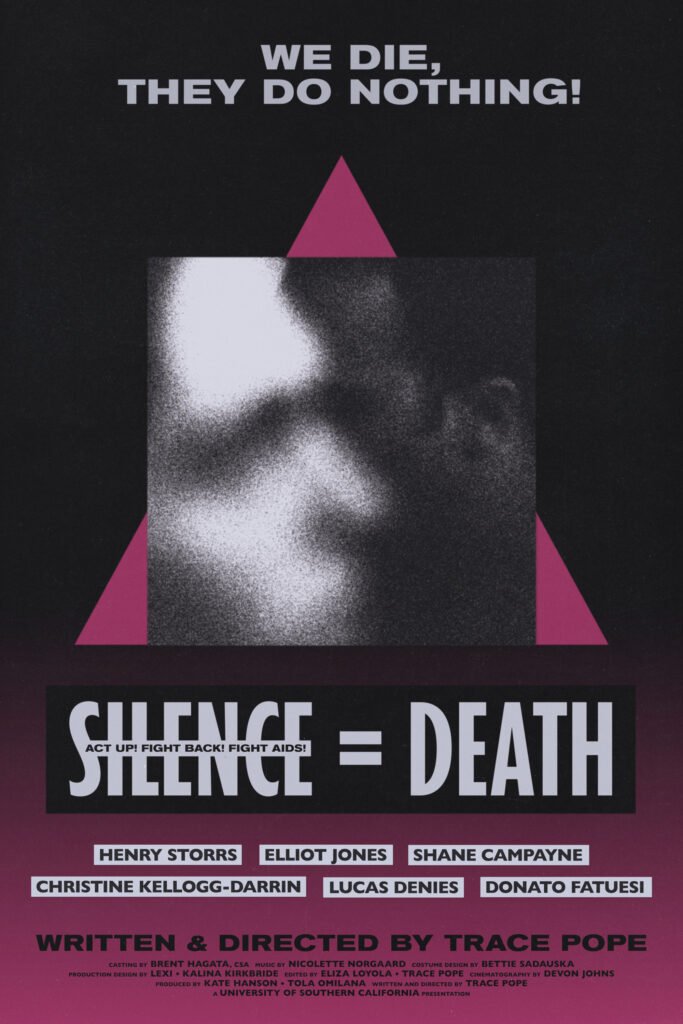
If Silence = Death proves anything, it is that memory is an act of resistance. Trace Pope does not approach this history as a distant archive, but as a living inheritance. It demands accountability, community, and creative rigour. As he develops the story into a feature-length ensemble, his commitment remains clear. He honours the activists who fought for survival, to question the institutions that moved too slowly, and to ensure that younger generations never again have to say, “I had no idea.”
In amplifying this story, he reminds us that silence has always been deadly and that art, when wielded with conviction, can still yield monumental results.
Riley Helm shows pure comedic genius in the cleverly titled short ...
"Music was the thing that saved me for sure." The documentary ...
Leave A Reply