
Tron: Ares — A Beautiful Machine Searching for a Soul
There’s something about returning to the TRON universe that always feels ...

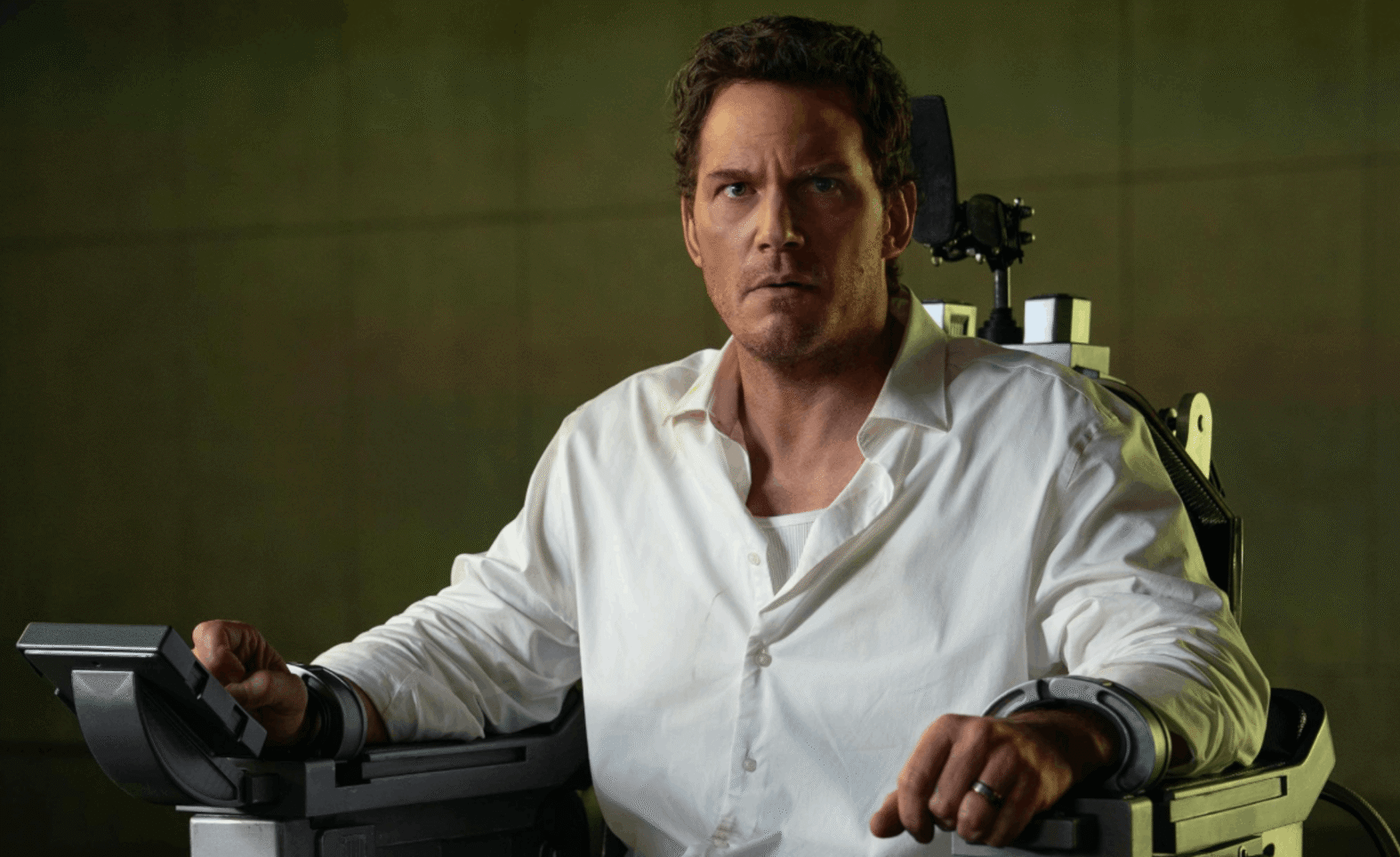
There is something deeply unsettling about watching a man plead for his humanity in front of a machine that does not care whether he has one.
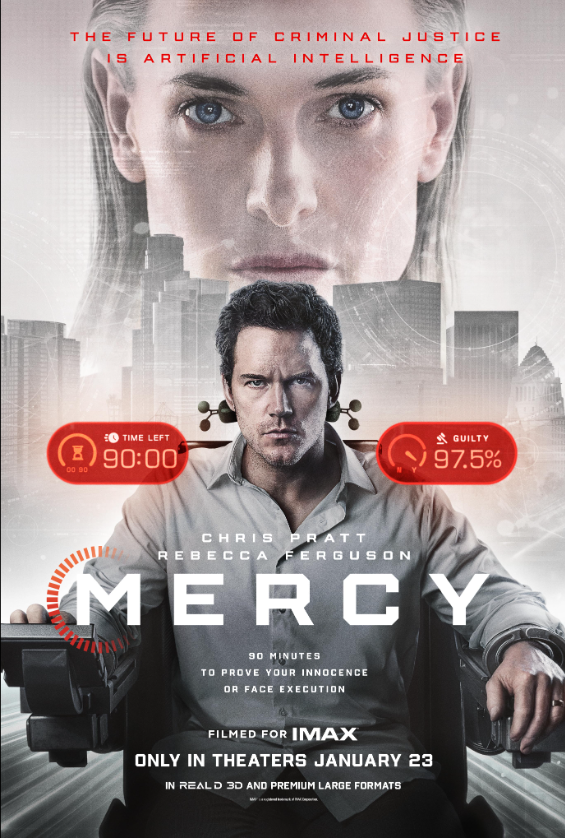
In ‘Mercy’, Timur Bekmambetov builds a near-future courtroom thriller around a concept that feels less like science fiction and more like a rehearsal for tomorrow’s headlines. The year is 2029. Artificial intelligence presides over criminal trials. Data is king, and surveillance is memory. Detective Chris Raven, played by Chris Pratt, has ninety minutes to convince an AI judge that he did not murder his wife.
Raven once advocated for this system as he believed in its efficiency, its impartiality and its logic. Now he is strapped to a chair, staring into the digital face of Judge Maddox, an AI embodied with chilling composure by Rebecca Ferguson. The very architecture he trusted has turned on him. There’s poetry in that irony. And for a while, Mercy thrives on it as that becomes the core of the story.

Timur Bekmambetov, long associated with the “screenlife” storytelling format, pushes the aesthetic further here. Floating interfaces crowd the frame. CCTV feeds overlap with social media logs. Bodycam footage interrupts courtroom exchanges. The screen becomes a battlefield of data. It’s aggressive, sometimes overwhelming, occasionally brilliant. The visual language mirrors the world it depicts: fragmented, hyper-digital, impatient.
There are moments when the film feels genuinely immersive. You are not simply watching Raven scroll through evidence; you are drowning in it with him. Every notification becomes a potential lifeline or a nail in the coffin. The 90-minute time limit cleverly aligns with the film’s runtime, giving the narrative a built-in pulse. The clock is not just ticking for him—it’s ticking for us.
For all its visual ambition, ‘Mercy’ struggles to make us feel the weight of what is at stake. Perhaps it is the very obvious lack of mood music that presents the narrative as empty. A man accused of killing his wife should be a powder keg of guilt, rage, heartbreak, and desperation. Yet Pratt’s performance, while competent, often feels restrained in ways that flatten the drama. He plays Raven as a man trying to stay composed under pressure, which makes sense logically. But cinema feeds on cracks in composure. We want to see the fracture lines; we want to see him really lose it, after all, his life is at stake here.
Part of the limitation lies in the film’s structure. Raven is physically immobilised for much of the runtime, confined to a chair while the world moves through screens around him. The narrative relies heavily on digital investigation: scrolling, cross-referencing, video calls, and archived footage. It’s clever in theory. In practice, it occasionally feels like watching someone assemble a PowerPoint defence under duress.
Ferguson, on the other hand, brings a quiet authority to Judge Maddox. With minimal physical presence, she projects an eerie calm. Her performance carries an undercurrent of something almost human curiosity? skepticism? without ever fully crossing into sentimentality.
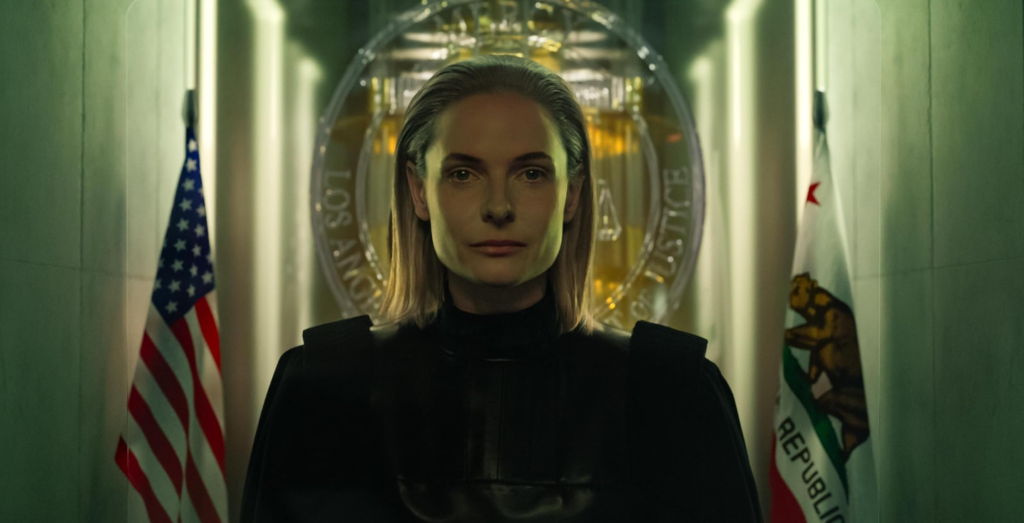
Ironically, the AI in the room often feels more compelling than the flesh-and-blood protagonist without a doubt. That tension may be intentional. It may also be the film’s sharpest commentary. Machines are learning how to perform humanity more convincingly than we expect.
And that is where the film resonates most. We live in a time where algorithms decide what we see, what we buy, whom we date, and increasingly, how we are evaluated. ‘Mercy’ does not need to exaggerate much. It simply extends our current trajectory a few steps forward and asks: what happens when judgment becomes purely computational?
The film’s action sequences, car chases, gunfire, and aerial pursuits inject bursts of adrenaline, particularly when the story breaks free from the courtroom’s digital cage. These moments remind us that Bekmambetov still knows how to stage spectacle. Yet even these sequences are filtered through screens, maintaining the film’s commitment to mediated experience. We rarely see anything directly. Everything is processed, framed, compressed.
And that may be the film’s greatest strength and its greatest flaw. The film feels like a mediation between truth and perception, between human feeling and machine calculation. But in leaning so heavily into that mediation, it sometimes creates distance between the audience and the emotional core of the story.
Still, there is value in what Bekmambetov attempts here. He is not content to make a conventional courtroom thriller. He wants to evolve the language of digital-era cinema. He wants to ask uncomfortable questions about our trust in systems. He wants to reflect a world where evidence is not found in fingerprints but in metadata.
Mercy may not be flawless. But it captures something honest about our moment: we are building tools that promise objectivity, yet we are feeding them with deeply flawed human histories. And when those tools turn back on us, logic will not comfort us.
There’s something about returning to the TRON universe that always feels ...
Cinema is one of the most powerful tools for preserving culture, ...


Leave A Reply