Rite of Way – Smart and Funny Always Works.
Riley Helm shows pure comedic genius in the cleverly titled short ...

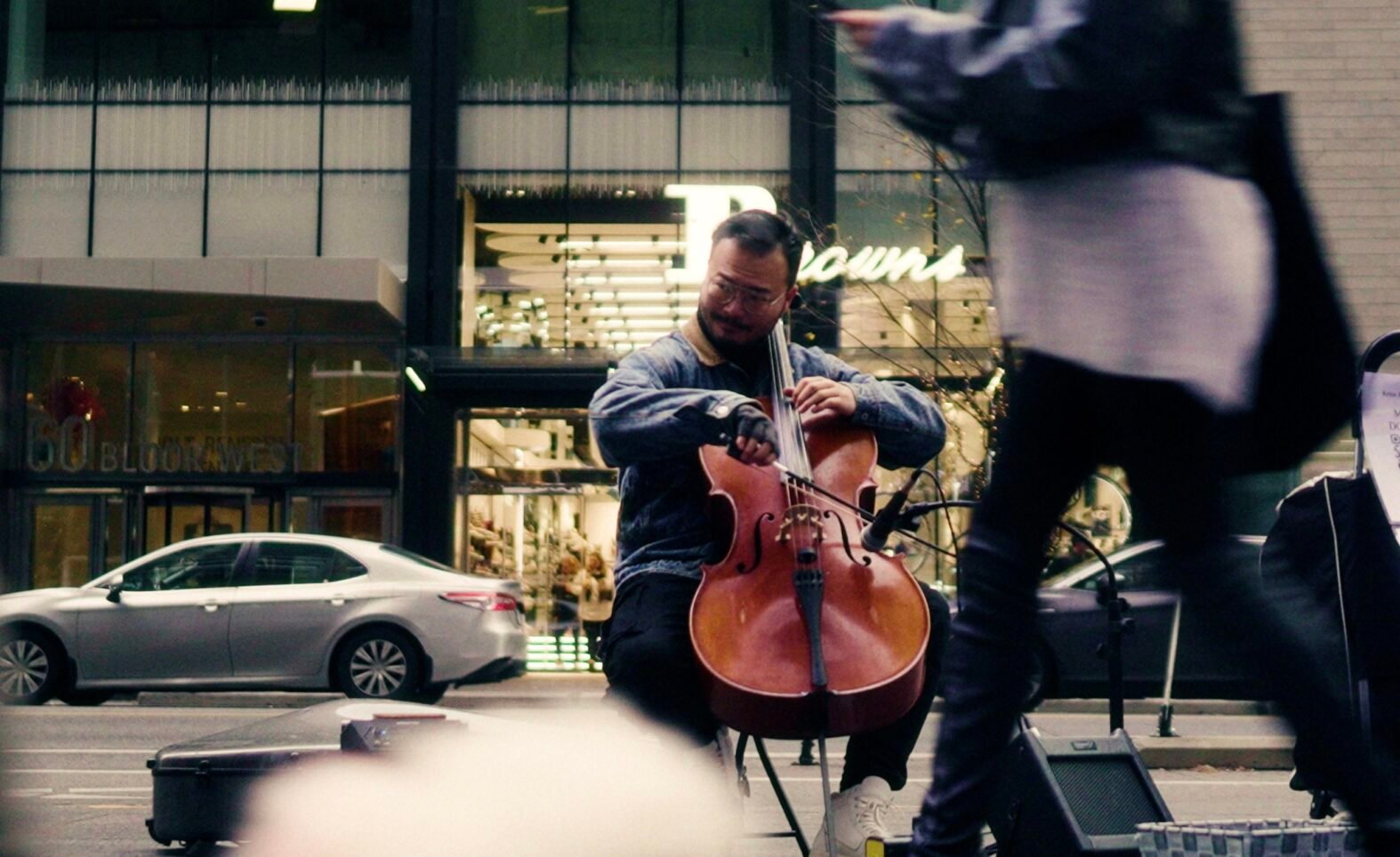
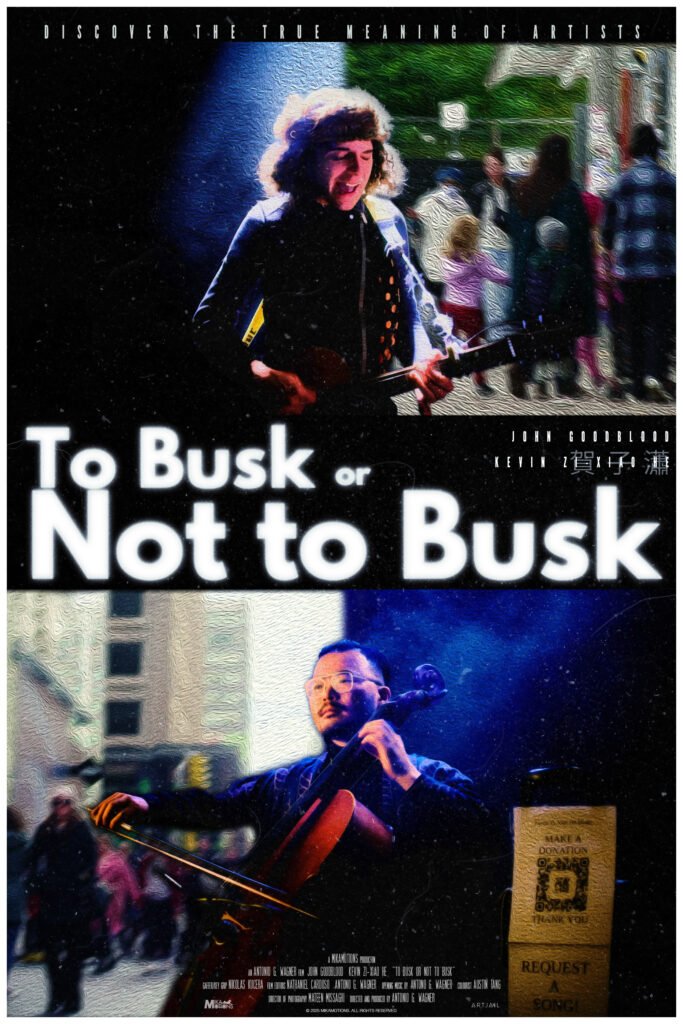
Antonio G. Wagner’s short documentary ‘To Busk or Not to Busk’ explores busking, one of the most public forms of artistic expression, where musicians perform, surrounded by crowds, traffic and judgmental glares. The film focuses on two immigrant street musicians whose reasons for performing extend far beyond financial necessity.
Running at just 15 minutes, Antonio G. Wagner’s documentary is concise but remarkably effective in examining what motivates artists to share their music in public spaces, often without recognition or sometimes even respect.
The first musician introduced in the film is John Goodblood, a charismatic performer whose tools are simple. A guitar and his voice. At 32 years old, John has spent roughly half his life busking, having started around the age of seventeen. His love for blues music served as the gateway into street performance, and over the years he has taken his music far beyond his local surroundings, even performing on the streets of Argentina.
What makes John’s story compelling is the way he describes busking not as a job, but as a form of liberation. For him, performing on the street removes many of the barriers often associated with the music industry. There are no managers to satisfy, no venues to book, no event crews to coordinate, and no dependence on social media algorithms. There is simply the music and the audience. He speaks about the experience with a sense of freedom that feels almost contagious and rebellious.
Busking becomes an extension of his political beliefs, particularly his refusal to pay for permits to perform. Yet beneath the defiance lies something more spiritual. John refers to busking as a cleansing of the soul, a phrase that encapsulates the emotional core of his relationship with music. Despite being labelled a “street musician,” his talents have also carried him onto some of the country’s biggest stages through talent competitions, reinforcing the film’s central argument that artistic value is not determined by where a performance takes place.
The documentary then shifts its attention to Kevin Zi-Xiao He, whose artistic journey provides an intriguing contrast. While John is rooted in blues and folk traditions, Kevin’s musical world is shaped largely by classical compositions performed on the cello. He began busking during the COVID-19 pandemic in 2021 when opportunities to perform in conventional venues disappeared almost overnight.
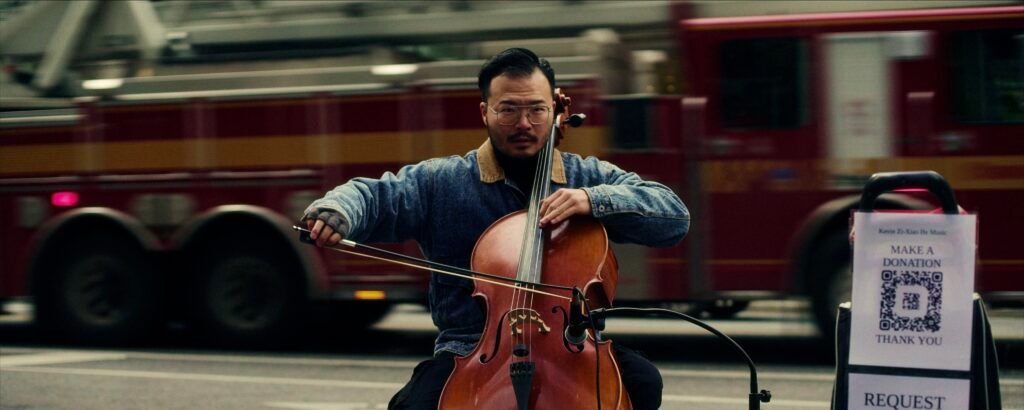
Kevin’s reflections are particularly revealing. He recalls that his first experience performing in public felt like being “very naked,” exposing not only his music but also himself to the judgment of strangers. It is a feeling many artists will immediately recognise. Encouragingly, the positive response and generous donations he received during that first session gave him the confidence to continue.
Kevin recounts an encounter with a parking enforcement officer who told him that his music was worth more than what he was receiving on the street. It is a comment that could easily be interpreted as praise, but it also reflects a broader societal perception that busking is somehow lesser than formal performance. Kevin’s response is particularly moving. He makes it clear that he does not seek donations out of sympathy. What matters to him is knowing that people contribute because the music genuinely moved them. It is a distinction that speaks volumes about his integrity as an artist.
Antonio G. Wagner presents both musicians through a blend of intimate talking-head interviews and observational footage. The interviews are filmed in a darkly lit studio environment, creating a contemplative atmosphere that allows the subjects’ words to take centre stage. These moments are interwoven with footage of live street performances, capturing not only the musicians themselves but also some interactions of passers-by.
The documentary’s greatest strength lies in its ability to humanise its subjects. Rather than romanticising busking or focusing solely on its hardships, the film presents a balanced portrait that acknowledges both the joy and uncertainty of the lifestyle.
By the time the credits roll, ‘To Busk or Not to Busk’ leaves viewers with a renewed appreciation for the musicians who provide the soundtrack to our cities. It succeeds in showing that busking is not merely about earning money or attracting attention. It is about creating fleeting moments of human connection through music.
Riley Helm shows pure comedic genius in the cleverly titled short ...
How far is a mother willing to go to protect her ...

Leave A Reply